
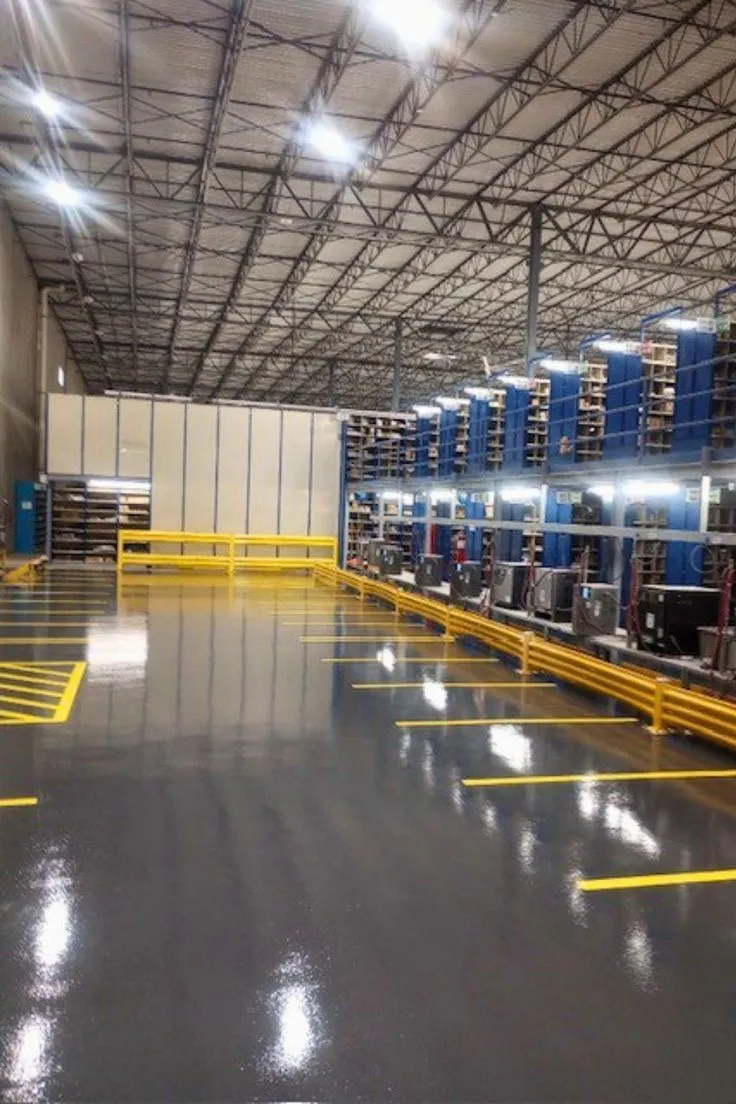
Warehouse flooring discussions often focus on long forklift aisles, yet pallet staging zones can experience even more concentrated stress. These areas sit between receiving, storage, picking, and shipping, so loaded pallets, forklifts, pallet jacks, and employees repeatedly converge in the same limited space. Vehicles stop, turn, reposition, and accelerate rather than simply traveling in a straight line. As a result, staging areas may develop worn coatings, chipped joints, impact damage, and difficult-to-clean patches sooner than nearby aisles. Treating them as distinct operating zones can improve repair planning and maintenance.
Staging Areas Concentrate Movement
A warehouse aisle mainly supports directional travel, while a staging area often requires constant maneuvering. Forklifts may approach from several directions, rotate loads, reverse, and stop repeatedly while orders are organized.
These movements create different mechanical forces on the floor. Turning tires can increase abrasion, and loaded pallet jacks can repeatedly cross the same small sections.
Managers should map these activities before resurfacing so the flooring specification reflects how the zone is actually used.
Pallet Placement Creates Impact
Not every pallet is set down gently. Repeated placement can create localized impact, particularly when loads are heavy or handling space is limited.
Concrete that already contains small cracks or weak patches may deteriorate faster under this repeated stress. Coating damage can also develop around areas where pallets are frequently placed, dragged, or repositioned.
When reviewing proposals from Warehouse Flooring Contractors, facility managers should identify staging zones that have a history of recurring damage rather than discussing only total warehouse square footage.
Joints Can Become High-Wear Lines
Staging areas frequently overlap with slab joints. If loaded vehicles repeatedly cross damaged joint edges while turning or stopping, deterioration can accelerate.
Chipped edges can create rough transitions that cause additional impact with each wheel crossing. Existing joints should therefore be inspected before a new resinous system is installed.
Some damaged sections may require repair, while functioning movement joints need treatment appropriate to their purpose. They should not simply be hidden beneath coating without assessment.
Debris Adds Abrasion
Stretch wrap fragments, cardboard, pallet splinters, dust, and outside grit can all accumulate in staging areas. When hard particles are trapped beneath vehicle tires, they may increase abrasion on the floor.
Regular housekeeping helps, but a worn or irregular surface can make debris removal more difficult. Cracks and damaged joints can trap particles that would otherwise be swept or scrubbed away.
A more continuous floor can support maintenance, provided the substrate beneath it is repaired and prepared correctly.
Preparation Should Match the Damage
Old coatings, tire residue, contamination, weak concrete, and previous repairs may be present in heavily used staging zones. Applying another layer over these conditions can leave existing weaknesses unresolved.
A qualified Warehouse Flooring Installer should evaluate whether mechanical preparation such as grinding or shot blasting is appropriate for the slab and planned system. Damaged concrete should also be repaired before primers and build layers are applied.
The finished surface is only as reliable as the substrate supporting it.
Traffic Markings Can Improve Organization
Staging zones often need clearly defined spaces for inbound pallets, outbound orders, pedestrian movement, and equipment lanes. Flooring renovation creates an opportunity to reconsider those markings.
A well-planned layout can reduce confusion and keep pallets from creeping into travel routes. Managers should verify dimensions and workflow before final lines are installed.
Markings work best when they support actual operating behavior rather than simply recreating an outdated floor plan.
Maintenance Should Focus on Turning Points
Routine inspections can be more effective when they concentrate on predictable stress areas. Forklift turning points, joint crossings, pallet placement zones, and door approaches deserve particular attention.
Small chips or worn sections are easier to address before repeated traffic enlarges them. Maintenance teams can also photograph recurring defects and compare them over time.
If the same area fails repeatedly, the pattern may indicate that traffic, substrate condition, or the flooring specification needs a broader review.
Conclusion
Pallet staging areas are among the most active parts of many warehouses, yet they are often treated as ordinary extensions of nearby aisles. Repeated turning, stopping, pallet placement, joint crossings, and debris can create concentrated wear that calls for closer attention.
By identifying staging zones during assessment, managers can tailor preparation, repairs, markings, and maintenance to their actual operating demands. Treating these areas as distinct flooring environments can reduce recurring damage and create a more reliable surface where material flow is often at its busiest.